Home / Sages & Sacred Texts

Our lineage

Sages & Sacred Texts

Every reading we prepare stands on the work of the great seers of Jyotish and the classic texts they left behind. This page honours them with short, respectful introductions.

The seers

Great sages of Jyotish

Where tradition and history differ, we say so. Dates for many ancient figures and texts are debated by scholars.

An elderly rishi with a long white beard and saffron robes writing on palm-leaf manuscripts in a forest ashram under a starry sky, lit by oil lamps
Brihat Parashara Hora Shastra

Maharishi Parashara

Revered in tradition as the father of Vedic astrology. Puranic accounts describe him as the grandson of Vasishtha and the father of Vyasa. The Brihat Parashara Hora Shastra is attributed to him and lays out houses, divisional charts, yogas and the Vimshottari dasha system. The text we read today was handed down and edited over many centuries, so scholars differ on its date.

An elderly sage in a white shawl on a hilltop at night gazing up at the Milky Way, holding a rolled manuscript beside a lamp
Jaimini Sutras

Maharishi Jaimini

Remembered as a disciple of Vyasa. His name is attached to the Jaimini (Upadesha) Sutras, a terse and distinctive system that uses chara karakas, sign-based aspects and chara dasha. Tradition also links him to the Purva Mimamsa Sutras; whether both works come from the same Jaimini is a matter of debate.

A sadhu drawing a geometric birth chart on parchment by the light of an oil lamp, with stacks of old manuscripts beside him
Brihat Samhita · Brihat Jataka

Varahamihira

A historical astronomer-astrologer of Ujjain, generally placed in the 6th century CE. His Brihat Jataka is a classic of natal astrology, and his Brihat Samhita is an encyclopaedic work on omens, weather, gems, architecture and more. Later legend counts him among the 'nine gems' of a King Vikramaditya's court.

An elderly sage in a white shawl on a hilltop at night gazing up at the Milky Way, holding a rolled manuscript beside a lamp
Bhrigu Samhita

Maharishi Bhrigu

One of the great rishis of Puranic tradition, often listed among the Prajapatis. The Bhrigu Samhita is traditionally credited to him and is said to hold readings for countless births. The manuscripts kept today by families of pandits differ widely in content, and their age and authorship are understood through tradition rather than history.

An elderly sadhu guru under a banyan tree explaining a kundli chart drawn on a board to five young disciples by lamplight
Garga traditions of Jyotish

Garga (Gargacharya)

An ancient sage honoured as a master of jyotisha. The Bhagavata tradition remembers Gargacharya as the Yadava family priest who named Krishna. Early astronomical and astrological teachings, such as the Vriddha Garga Samhita, are attributed to Garga or his lineage; the name may refer to more than one teacher.

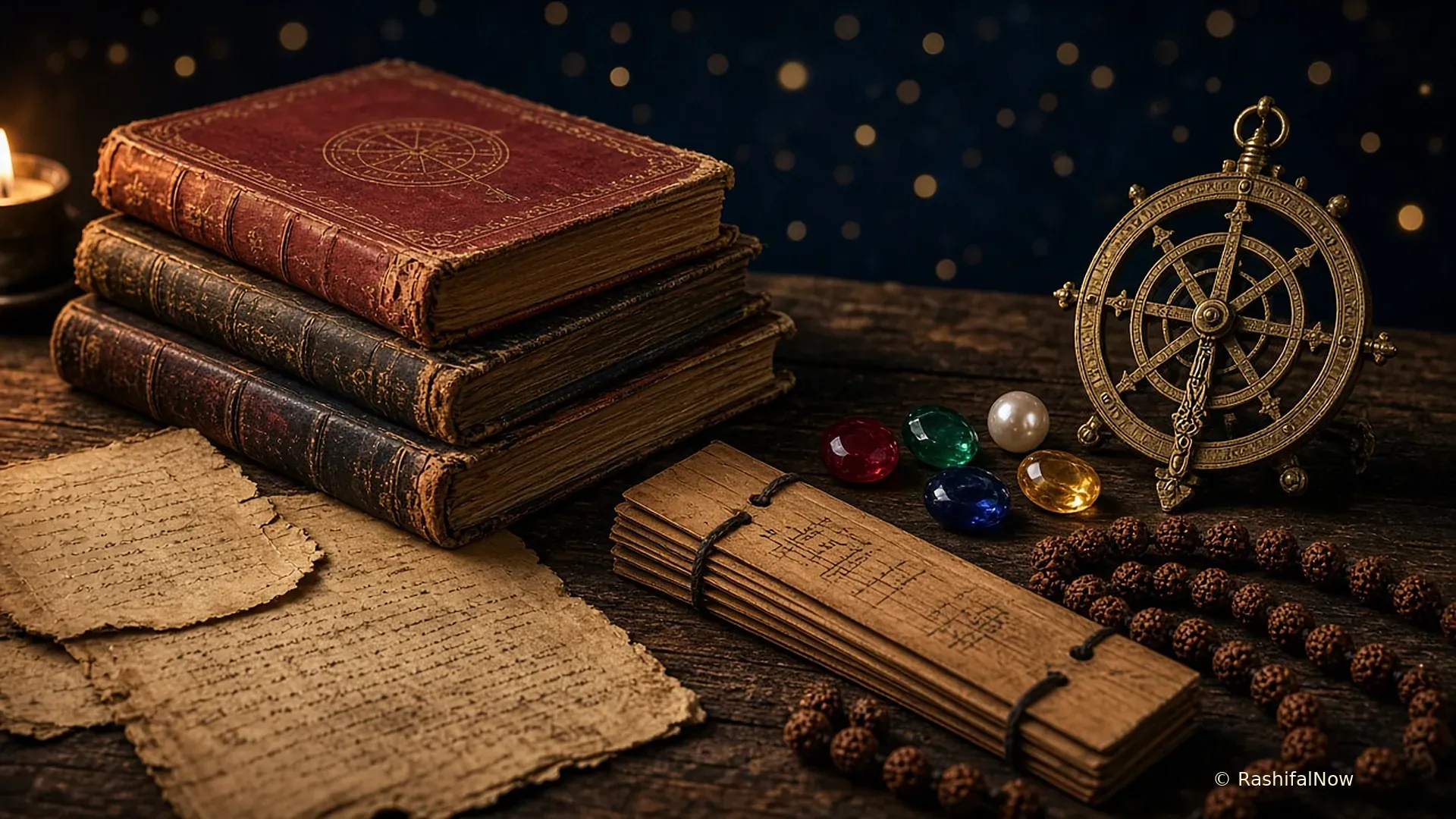
Old cloth-bound astrology books, palm-leaf manuscripts, rudraksha beads, gemstones and a brass astrolabe on a wooden table by candlelight
Aryabhatiya (499 CE)

Aryabhata

A historical mathematician-astronomer, born in 476 CE according to his own work. The Aryabhatiya covers planetary motion, eclipses and trigonometry, and proposes that the Earth rotates. He was an astronomer rather than a predictive astrologer, but the calculation of planetary positions that every kundli relies on owes much to his tradition.

An elderly sage in a maroon shawl reading a cord-tied bundle of palm-leaf manuscripts beside a brass oil lamp and an aged scroll
Ravana Samhita (traditional attribution)

Ravana

Known to the Ramayana as the king of Lanka, Ravana is also remembered in many traditions as a learned scholar and a devotee of Shiva. The Ravana Samhita is traditionally associated with him. Texts circulating under this name vary a great deal, mixing astrology, remedies and other subjects, and the attribution is one of tradition.

Artistic depiction inspired by tradition · AI-generated video, not a historical record
Guru–shishya parampara

Knowledge passed from teacher to student

For centuries Jyotish was learned at the feet of a teacher: charts drawn on the ground or on palm leaves, verses memorised, and every rule tested against real lives. Our astrologers carry that spirit into each paid reading.

Book a Kundli Reading
The classics

Sacred texts of astrology

Brihat Parashara Hora Shastra

Attributed to Maharishi Parashara

The foundational text of Parashari astrology: the twelve houses, divisional charts (vargas), yogas, dashas and remedial measures. Popular editions run to about a hundred chapters.

Ravana Samhita

Traditionally associated with Ravana

A body of texts known by this name, spanning astrology, remedies and related lore. Versions differ considerably, so it is best read as a living tradition rather than a single fixed book.

Lal Kitab

Pt. Roop Chand Joshi · editions 1939–1952

A set of Urdu-language works published in Punjab between 1939 and 1952 and generally credited to Pt. Roop Chand Joshi. It is known for its distinctive house-based approach and its simple, practical remedies (upay).

Bhrigu Samhita

Traditionally credited to Maharishi Bhrigu

Renowned for collections of horoscope readings preserved by families of pandits. Copies differ from place to place, and each tradition guards its own manuscripts.

Saravali

Kalyanavarma

An extensive work on natal astrology, commonly dated to around the 9th–10th century CE. It builds on earlier authorities, including Varahamihira, and is valued for its detailed planetary combinations.

Phaladeepika

Mantreswara

A concise South Indian classic on predictive astrology, prized for its clear rules on houses, yogas and dashas. Its date is debated; estimates range across several centuries of the second millennium CE.

Jaimini Sutras

Attributed to Maharishi Jaimini

Short sutras in four chapters that set out the Jaimini system. They are compressed and often coded, so they are usually studied with traditional commentaries.

Brihat Jataka

Varahamihira

A cornerstone of natal astrology, written with great economy. The 10th-century commentary of Bhattotpala has long been a standard companion to it.


Artistic depiction inspired by tradition · AI-generated video, not a historical record
Copied by hand

How the texts travelled

Before printing, these works survived because students copied them, leaf by leaf, and carried them from teacher to village to court. That is one reason editions differ: each manuscript line has its own readings, and scholars still compare them today.

An elderly sage in a maroon shawl reading a cord-tied bundle of palm-leaf manuscripts beside a brass oil lamp and an aged scroll
Manuscript traditions

Palm leaves, lamps and patient study

Works such as the Ravana Samhita and the Bhrigu Samhita survive through manuscripts copied by hand and guarded by families of scholars. Their contents differ from one collection to another, which is part of what makes them so fascinating to study.

A devotional artwork of Lord Ganesha seated on a lotus, raising a hand in blessing, with diyas and a starry night sky behind him
Auspicious beginnings

Lord Ganesha

Revered as Vighnaharta, the remover of obstacles, Lord Ganesha is invoked first at the start of any new undertaking. Many astrologers begin the reading of a chart with a prayer to him, and so do we.

Paid reading

Book a Kundli Reading

Your birth chart prepared and explained in the classical Parashari way.

from ₹— pricing to be announced
Pay & Book
Paid consultation

Get a Paid Consultation

One-to-one time with an astrologer on any question that matters to you.

from ₹— pricing to be announced
Pay & Book

These introductions are short summaries drawn from tradition and general scholarship, written for RashifalNow. Images on this page are original AI-generated artworks; they are imaginative depictions and not portraits of any historical person.

Talk to an astrologer